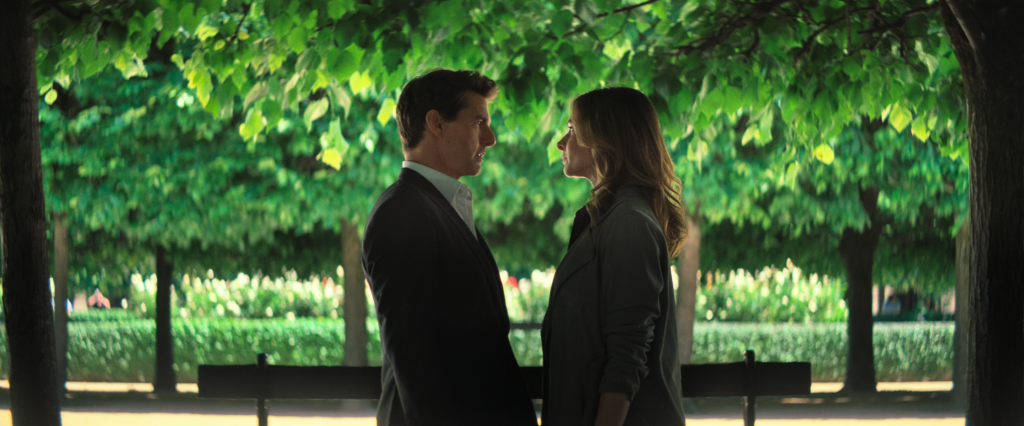
My favorite moment in Mission Impossible: Fallout isn’t the extremely thrilling HALO jump that kicks off the action, or the brutal and perfectly choreographed nightclub bathroom fight scene where Henry Cavill famously reloads his arms. It isn’t the queasy Paris motorcycle chase that ends up going the wrong way in a roundabout, or even the very long and very funny montage of Hunt running as fast as he possibly can across rooftops.
It’s not even at the end, where a fistfight ensues on a cliff after an impromptu helicopter chase of Fury Road-like intensity has ended up in the Alps of Kashmir. Although I’d be remiss not to consider the moment where Tom Cruise’s superspy hangs off the side of a mountain, as the device needed to stop a bomb from exploding teeters precariously at the top. The weary Hunt has no other option but to start scaling the very steep cliff, an organic callback to the iconic rock-climbing scene from 2003’s Mission Impossible: 2.
No, it’s the second of the film’s three dream sequences spread throughout the story. In the first, the opening scene, Hunt has a nightmare that somehow predicts the rest of the film. He is renewing vows with his ex-wife, Julia, only for the minister to reveal himself as Rogue Nation’s terrorist Solomon Lane. Lane’s script veers from the traditional vows to portray Hunt as selfish and a liar (the real-life Lane repeats these same lines to Hunt in person later in the film, drawing a horrified reaction). The third, late in the runtime, is a simple scene where he sees Julia and Lane again, after which he wakes up to the rest of the IMF team watching him intently.
But it’s the second dream, sandwiched in the middle of the film, that truly defines Hunt as a character. Undercover as a murderous extremist, he is asked by arms dealer White Widow if he can aid in a violent extraction of Lane the next day. Their plan: kill everyone. Hunt zones out and imagines himself leading a team of soldiers in the attack as they mow down dozens of police officers. Lorne Balfe’s beautifully somber score plays as Hunt walks silently towards an innocent cop. He takes off his mask and pulls the trigger. We cut back to Hunt as he stares at the Widow and says incredulously, “Kill everyone?”

Hunt isn’t an anti-hero, or even a character with shades of grey. In fact, he’s barely a character at all. His sole motivation in all of these movies is to train and push and run and shoot and fight as hard as he can until he saves the day. And in Fallout, a movie about the repercussions of good intentions, he worries that that’s not good enough. He obsesses and dreams about his past relationships, mistakes, and failures. At the end, when he is finally reunited with his ex-wife, he lies in a hospital bed and practically sobs about how sorry he is.
While it’s all deeply silly, there’s also an undeniable freedom to crafting such a simple story. Hunt finds his initial mission delivered in a copy of Homer’s The Odyssey, a reference to his suppressed desires to return home with his wife. Afterwards, McQuarrie and Cruise put all of their focus and time into creating impossible situations for Hunt to squirm his way out of, situations where any mortal man wouldn’t last five minutes. There are about 15 action scenes in this movie, each one more exciting and pulse-pounding than the last, and Cruise throws himself into each of them with the fervor and energy of a man possessed. You can literally watch the actor break his ankle in an incredible top-down leap across rooftops.
McQuarrie tells us that Hunt is a hero, and he deserves to win, so he will. Our hero avoids his paranoid delusions by simply running faster, fighting harder, and thinking more quickly than the other guy. When he loses, he gets back up and sprints past you. It’s a fantasy that feels akin to Raimi’s Spider-Man 2, or maybe even the old Superman movies. Fallout is a perfect action movie because it doesn’t have a shred of cynicism—the action is the story, and when done this well, that’s enough. 12-01-23

 Story Over Thought
Leave a comment