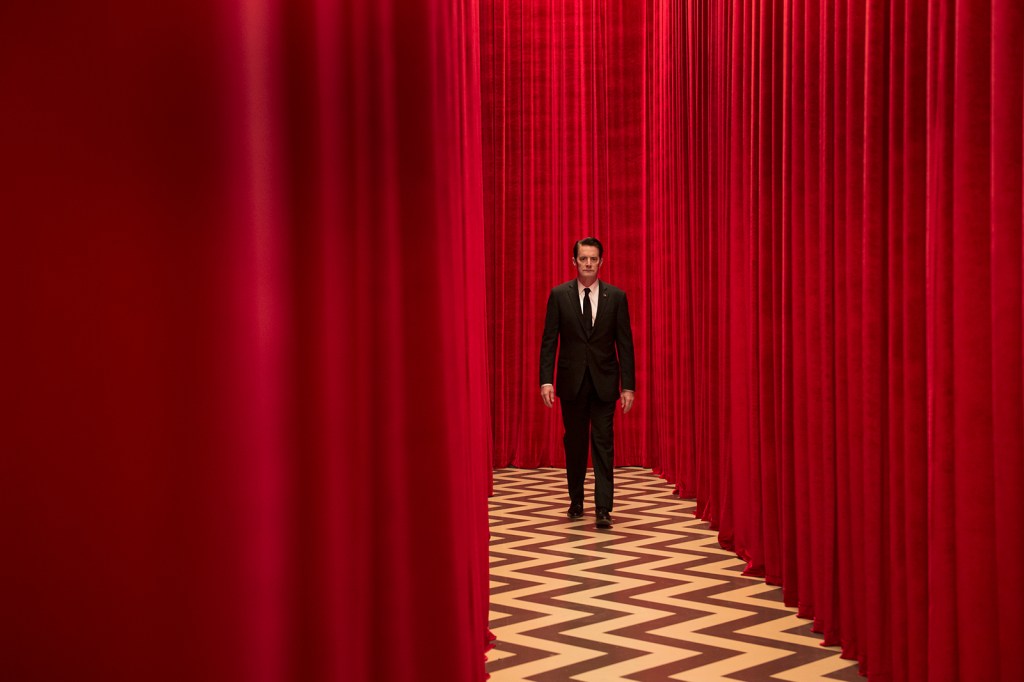
I have so much to say about the third season of Twin Peaks, but the task seems so daunting. In many ways, eighteen-hour movie The Return is anything but; David Lynch’s sprawling, grandiose, very funny, and deeply, deeply frightening film reminds us over and over that there is no past to return to. Yesterday is nothing but a memory. There is no going back. The penultimate episode seems to finally acquiesce and give us a fan-service conclusion, only to pull the rug out and force us to grapple with our own selfish desire to rewrite history if it will help us sleep a little better.
So maybe I won’t write a full analysis just yet. Maybe I’ll just get my initial thoughts jotted down so I have something to refer to later. Firstly, The Return is a work of art. Simply talking about the events and plot developments of the show does not give justice to the overall tone and character that Lynch and Frost build. Like how nearly every episode ends with a performance from a live band at the Roadhouse, with guests ranging from Eddie Vedder to The Chromatics to Nine Inch Nails. It reminded me of Only God Forgives and Lieutenant Chang’s karaoke performances to his police squad. They play like surreal prayers for understanding, for absolution.
Consider, as well, all of the topical themes that The Return tackles. The opioid epidemic, suicide, gun violence, and corruption of the youth are all subjects that weave organically into the primary theme of the past being forever gone. Dr. Jacoby, the eccentric psychiatrist from the original series, now has a podcast where he rants and raves about the chemicals being poured into the water. His solution? Selling shovels that have been spray painted gold. “Shovel yourself out of the shit!” he screams, literally selling trash back to his eager fans.
There are also the three Jungian archetypes that Cooper is split into at the beginning of the season. We have the original Cooper, the hero, who escapes the lodge at the beginning of the season after 25 years of imprisonment, only to have his brain scrambled in the process. Dougie, the innocent, is the clone that Hero Cooper becomes stuck in. He is practically a child, seeking simple pleasures and coffee. BadCoop, Cooper’s doppelganger from the Black Lodge, is the shadow, representing the dark and more repressed desires of Cooper through lots of scowling and long hair. Nearly the entire season focuses on either the child or the evil version of Cooper, delaying the eponymous return that we’re all here for. Dougie gets involved in the most precarious and deadly situations imaginable, but hilariously, always makes it out alive through sheer obliviousness. BadCoop is ridiculously malicious and, at one point, seizes control of a gang by winning an arm-wrestling match. I interpreted the whole thing as a commentary on the modern television landscape, where protagonists are often either a Mary Sue or a grizzled anti-hero.
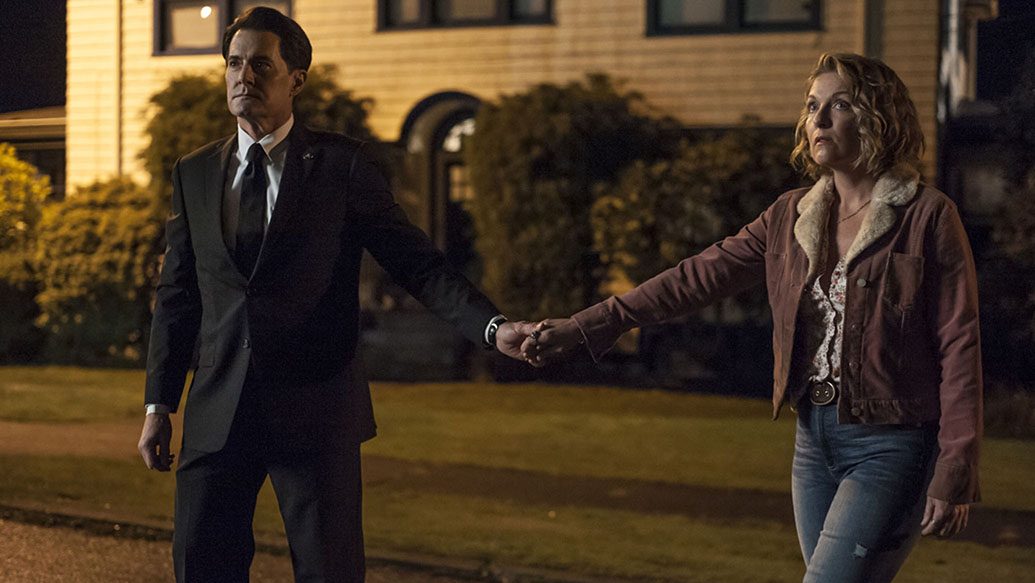
When the real Cooper does eventually return, he’s neither the simple and lovable Dougie, nor the edgy, male fantasy of BadCoop. He’s a real person, an idealistic but flawed detective who has spent his entire life trying to solve a mystery that has moved on without him. He’s a Dale Cooper who is tragically realistic. 25 years of racking his brain over Laura and his desire to “fix” things have turned into an obsession. After defeating BOB with the help of a literal superhero, Cooper goes back in time to prevent the death of Laura. In the finale, he arrives in a pocket universe where she is known by a different name. For some reason, he forces her to return to Twin Peaks, where she suddenly remembers her past, and the world seemingly ends. What does it all mean? If it looks like something is very wrong, and smells like something is very wrong, well, then, there you go. It’s particularly disturbing because Cooper is a good person. His quest is noble. It’s the rare case where a series makes its leading man more complex by actually making him care too much.
Stepping back a bit, I have to talk about Part 8. Lynch and company decide to go on an absolutely insane tangent, exploring the origins of the Black/White lodge characters in a bizarre, nearly silent black-and-white mini movie. In an expert example of visual storytelling, we learn that the Trinity nuclear tests in New Mexico opened the portal for BOB to enter the world. Born as a disgusting frog/insect hybrid, he finds Sarah Palmer as a child and climbs inside her mouth. Somewhere out in space, the Giant (credited as “The Fireman” in this season) creates a golden orb that contains the face of Laura, which he sends out into the world. This can all be interpreted in a variety of ways (and I’ve read them all – the frog is Laura, the Giant is God, etc), but the intention is clear: a new evil entered the world when we found out we could destroy the entire planet, one that we still haven’t quite come to terms with. “Judy,” the Lovecraftian Big Bad mentioned by Philip Jeffries in Fire Walk With Me, is alluded to over and over but never explicitly shown on screen. Like the shark from Jaws, it is a personification of the unknown that must be faced to move forward, and away from the past.
I had a tough time keeping track of all the various subplots and clues and mysteries, but in many ways, I think they’re breadcrumbs to an empty shelf. Half of them don’t have any conclusion. Others lead to nowhere. Sure, there might be a “true” way to interpret the series and the incredibly confusing finale, but I don’t know if I care to piece them all together. The emotional message is clear, and I think it’s best summed up by the Audrey subplot. Audrey, a character whose goals always seemed unknowable in the original series, returns in a strange vacuum in which all her scenes consist of her angrily swearing at her “husband,” who seems to double as some sort of therapist. She talks again and again about returning to the Roadhouse but never leaves her husband’s office. Towards the end of the season, Audrey finally appears on the dancefloor, as her theme from the original show is played live by the band. She begins to dance, but something is wrong. Her expression shifts to fear and we smash cut to her horrified face in a mirror, surrounded by white. The implication is obvious, but I just wanted to share how unsettling I found this subplot/scene. I can’t think of anything scarier than being swallowed up by ego or regret, driven mad by the desperate desire to go back to so-called simpler times.
For Lynch, Laura’s death was solved. Her story was over. She moved on from her trauma, quite literally ascending to heaven in Fire Walk With Me. Cooper’s dogged determination to prevent her suffering from ever occurring—while admirable—only perpetuates the cycle and forces the victim to experience the same terrible memories all over again. Time is meant to be spent healing, not agonizing over failure. I could talk at length about how this remarkable season so unsettlingly explores this truth—the final two episodes have layer upon layer to unpack—but I will “return” to Twin Peaks at a later date. For now, I wholeheartedly recommend Twin Peaks: The Return, but only if you’re ready to be challenged, both by a marked disdain for nostalgia and radically subversive storytelling. 02-24-24


 Story Over Thought
Leave a comment