
A few days ago, I was discussing religion with some co-workers. One of my friends brought up how religion has been a constant source of suffering and evil across the course of human history, and about how largely unnecessary and harmful it has been to society. While I can’t deny that some of that is true, it’s also true that many heinous acts have been committed in attempts to destroy believers who are simply trying to practice their faith in peace. The war between faith and non-faith is so vitriolic because no matter what you believe, you believe the other guy is wrong. So why is anyone surprised at how combative America is today? We’ve been conditioned for thousands of years to fight for what we believe in, to prove that we’re the ones in control. And “we” is not just America, or me, or you. Everyone. Prisoners is so interesting because instead of condemning faith or the lack thereof in God, it condemns trying to be God.
This theme is personified through both Keller Dover (Hugh Jackman) and Holly Jones (Melissa Leo), the primary protagonist and antagonist, respectively. Dover’s children are kidnapped early on in the film, and the mentally handicapped Alex (proto-Riddler Paul Dano) is taken into custody as a suspect. Alex taunts Dover, indicating he knows more than he lets on, and Dover becomes obsessed with finding his children. After Alex is released due to a lack of evidence, Jackman’s character takes him hostage and brutally tortures him around the clock. It’s an awful thing to do, but Dover prays constantly for guidance, believing the act to be a necessary evil. Dover, who is established as a religious man almost immediately (the film opens with him praying while on a hunting trip with his son), paradoxically demonstrates a complete lack of faith in God. He can’t sleep at night knowing his kids are gone. He can’t rest knowing Alex is harboring secrets. He has to be the one solving the problems, so he takes matters into his own hands at every step. Dover is all ego and self-reliance. The end justifies any means. He can’t even finish the Lord’s Prayer at one point because trying to recite the part about forgiveness makes him put his head in his hands.
Holly Jones, Alex’s “aunt,” is a serial kidnapper who started abducting children with her late husband after their son died of cancer. Alex was their first victim and Dover’s children is their latest. Their reasoning, explained in an excruciating exposition-heavy conversation with Dover, is that God is evil for taking their son, and that by ruining the lives of other parents, they are taking their revenge. Holly is much easier to quantify as a “villain” compared to Jackman’s character, but they are both motivated by the urge to stop their own suffering at any cost.
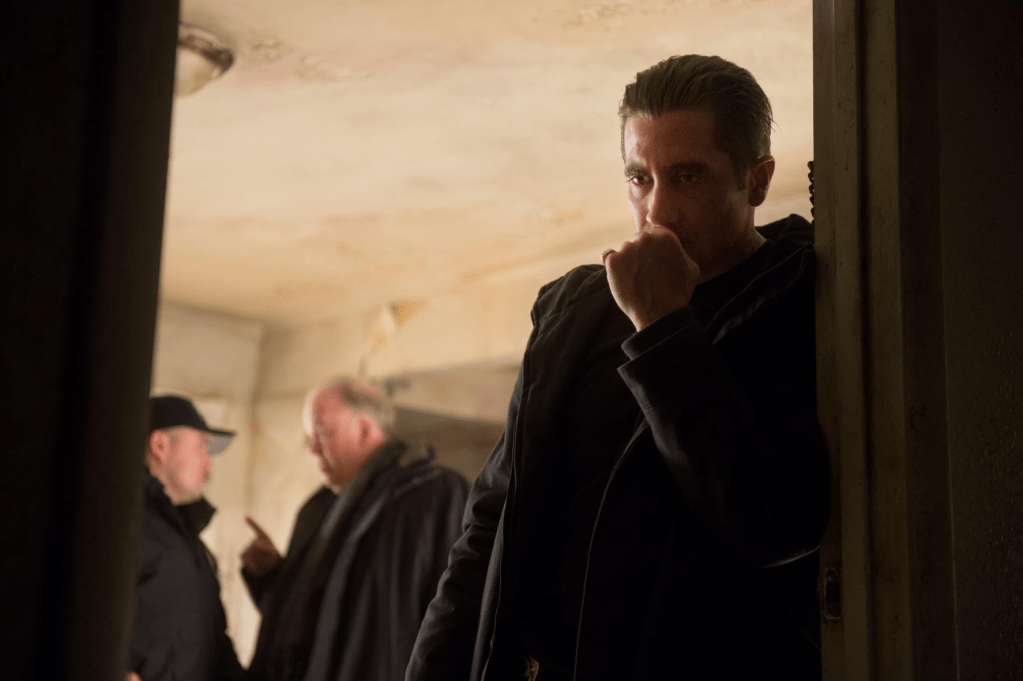
At first, Jake Gyllenhaal’s Detective Loki seems ill-fitting within this framework. He exists only to investigate, interrogate, and, eventually, save the day. If we were to extend the religious metaphors, however, Loki likely represents God himself. Probably not the Abrahamic God, but a deity nonetheless, or at the very least an angel. When Dover prays for help, he shows up immediately. When Dover confesses, Loki finds out. When Dover is captured by Holly and locked underground, Loki saves his children and is implied to be the one who rescues him. In fact, every interaction between the two men consists of Dover angrily accusing him of doing nothing about the case—but Loki always assures him justice is coming.
I’m not going to pretend that the answer to the problems of the world today is for people to become apathetic pushovers who spend all their time with their heads bowed (although, then again, that’s how many Biblical characters could be described). But it isn’t faith that drives Dover to commit horrible deeds; it’s the lack of it. Dover is a Christian who is afraid that no one is listening when he prays for justice, so he resorts to bashing a mentally handicapped man with a hammer—and uses God’s silence to justify it. On the flip side, Holly hates the idea of a merciful God, so she tries to destroy the faith present in others. She’s a “believer” like Dover, but her belief is that the universe isn’t just or fair for her, so it shouldn’t be for anyone else. When she tries to destroy that faith in others, Loki delivers biblical judgment.
Of course, that isn’t the only way to interpret the encompassing symbolism in Prisoners. If we want to focus on the detective aspect, then perhaps Loki represents the more rational, logical side of humanity—one that doesn’t place faith in anything but evidence. His pagan tattoos add a bit of credibility to this theory, as does, well, the whole bit where he actually solves the Fincher-esque mystery through critical thinking. His escape from the metaphorical “maze” alluded to so often could be contrasted with Dover, who ends up trapped underground.
Mazes recur throughout Prisoners, not just as symbols of confusion, but as visual embodiments of the fear that ensnares nearly every character. Dover is trapped by the fear of failing his children; Alex by fear of Dover; Taylor by the fear of confronting and voicing the unspeakable horrors he has witnessed; Holly by the fear of a universe that has denied her justice. Loki, in contrast, performs a courageous act at the film’s climax when he drives Dover’s child to the hospital while fading in and out of consciousness. The film suggests that the most destructive acts emerge not from faith itself, but from the anxiety in its absence.
I really like the ending of Prisoners, where Dover, having been trapped in the same hole his children were held in, prays a final time. It’s not for his own safety or for redemption, but for the well-being of his daughter. “Almighty God…protect my girl.” It’s Dover admitting that he can’t do it alone. He’s imperfect, flawed, and weak. Human. After blowing a whistle left by his children, it’s implied that he is heard and freed by Detective Loki. Dover’s potential deliverance from the maze, just like an escape from his physical prison, isn’t something that he could ever do by himself. He has to come to terms with the fact that his survival is reliant on something external. That’s not something most people want to believe in. 04-03-24


 Story Over Thought
Leave a comment