Foreign films getting remade in English is nothing unusual, especially horror. Just last year we got the Americanized Speak No Evil, a remake of the Danish-Dutch original from 2022. If you recall, there was some debate about whether the remake captured the original’s spirit, since (spoilers) the original ended with the family’s shocking demise, while the retelling has them kill their captor and escape. According to director James Watkins, this change was necessary for an American audience. “I didn’t want [the family] to be completely compliant. I didn’t believe they would be,” he explained.
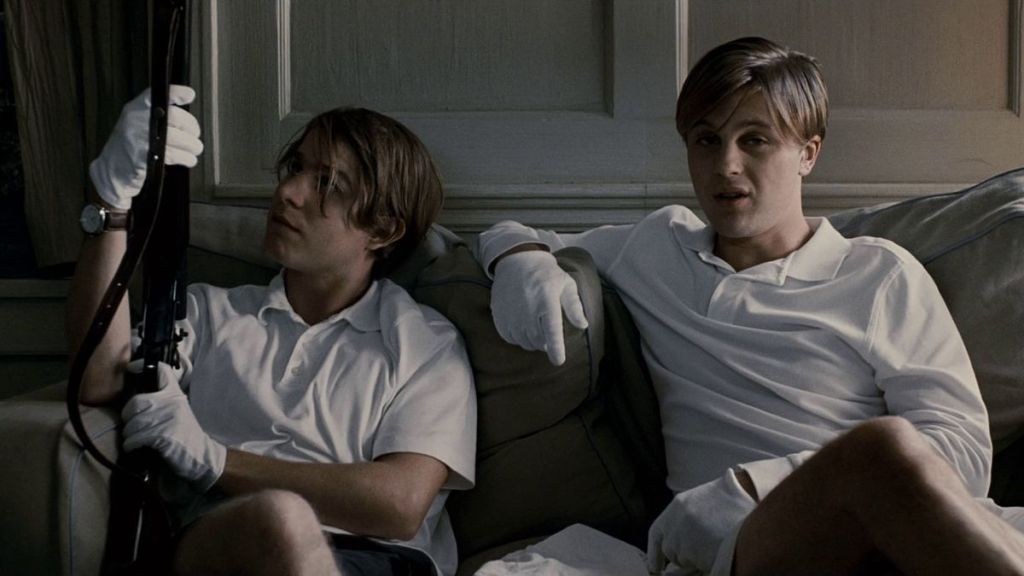
By contrast, the 2007 English remake of Funny Games is a shot-for-shot replication of Michael Haneke’s own 1997 German-language film. Both films have the exact same writer/director, screenplay, and identical endings. In fact, the only obvious differences are a new cast and an otherwise new crew, which merely results in some altered line readings and improved cinematography. You will likely guess that remaking a movie this way must mean that the director felt he missed something obvious the first go around, that some sort of clear and fatal flaw ruined an otherwise successful creative endeavor. Hanake’s reason for shooting a remake with virtually zero substantial changes? That the original was not set in America, a budgetary roadblock that prevented the film from reaching its target audiences: Americans.
This is because neither version of Funny Games is your traditional home invasion thriller. These films are confrontational, fourth wall breaking pieces of metafiction that attempt to accuse the audience of being complicit in the horrors onscreen, an obvious and distinctly postmodern response to exploitative, ultraviolent American slashers. Hanake seems to question if graphic violence for its own sake is problematic, and he asks you to think twice about enjoying it – even if this angle was a relatively late addition to the screenplay, a small but provoking detail in its own right. But while the central theme of a film like this can only be described as condescending, it’s a thesis that is extremely well crafted, using subversion and genre expectations to lure the audience into an ending that forces them to either recognize the manipulation of narrative, or laud a story that exists simply to torture its protagonists.

Consider how the family is introduced at the beginning. The mother plays some classical music in the car, nudging the father to try and guess the composer. It’s quiet, domestic. Suddenly loud, abrasive rock music blares as we see the title card in huge red block letters. It is an opening that doesn’t establish anything about the characters beyond the fact that they are happy and safe. There’s no setup about alcoholism, abuse, or marital strife, no narrative cues that usually hint at a fatal flaw within the family’s dyanmic. Only the score and title card boldly advertising a wild ride for the sickos out there. Ironically, this introduction makes the protagonists feel more like real people, since their motivations, backstory, and relationships have nothing to do at all with the events of the story. Their suffering is arbitrary. One of the most important things to keep in mind when discussing Funny Games is that the subversions and narrative switcheroos make the film more frightening, not less.
The bulk of this subversion flows through the film’s antagonists, Paul and Peter (Michael Pitt and Brady Corbet), two boring young men dressed in white who take the family hostage for no clear reason. As Hanake describes them, two stereotypes walking into the real world. There is a scene early on where the father George (Tim Roth) asks for an explanation. Peter makes up a story about parental abuse, switches it to the influence of drugs, then finally decides on “why not?” Does it really matter? They are also remarkably thoughtful, in a patronizing sort of way. The boys offer tending to George’s wounds (that they inflicted), use please and thank you, and even warn that the family “might get hurt” should they ignore their commands. Crucially, these deviants are aware of their existence and purpose within the story. When Paul forces the mother Ann (Naomi Watts) to search for the family dog in their first “game,” he looks directly at the screen and smiles. In the original, he even winks. Ann is then prompted to open the trunk of their car, and the dog tumbles out lifelessly onto the ground.
By breaking the fourth wall, Hanake rather bluntly challenges the audience, asking them if they are interested in continuing to watch a horror film where the perpetrators control the story. This choice couldn’t be clearer when the two propose a bet with the family: Paul bets that they will be dead in nine hours, and by nature of trying to survive, the family bets they will live. He then turns to the camera and asks the viewer directly what they think will happen. “You think they stand a chance? You’re on their side, aren’t you? Who are you betting on?” It’s a unique enunciation of the relationship between a genre film and audience expectations. We don’t know exactly what’s going to happen in a film like this, but we expect that there’s going to be gore, kills, death, and suffering. If it’s implied no catharsis is coming, does it matter? What are we really here for?
Some of Hanake’s commentary is overt, but there are also more subtle ways that the director reframes cliches or probes the viewer, which also avoids hypocrisy. There is a scene where Ann is forced to undress, but it contains no nudity, focusing exclusively on Ann’s tears and disoriented expression instead of serving as titillation. There is also no gore in the film (save for one shot that we’ll mention later). All of the violence performed on the family is either out of frame, implied, or depicted in a way that specifically avoids aesthetic satisfaction. The camera mostly lingers on the reactions of Ann and George, meticulously documenting their torment and anguish in a situation they cannot escape. One merely needs to look at the poster to see what the film will deliver. As another film once put it, “a woman in trouble.”
Speaking of Lynch, the approach is comparable to Twin Peaks: Fire Walk with Me, a piece that deconstructs audience expectations by forcing the audience to revel in the pain and suffering of its doomed protagonist. While the series accustomed viewers to a world far more lighthearted and quirkier, the film alienated those viewers by nosediving sharply into exploring intense grief and despair. If Lynch gave you the whole box of cigarettes to smoke at once, then Hanake is pointing out there’s a hand offering the box, that you can question their intentions, and that you are free to reject their offer at any point.
This dynamic is most memorably illustrated in the film’s infamous remote-control scene. After Ann manages to grab a shotgun and graphically murders Peter, Paul grabs the TV remote, rewinds the scene, and undoes the event. It’s a jarring, absurd assertion of control, but not for the characters. For Haneke. Stories do not necessarily belong to the victims or the audience, they belong to the storyteller. This is, of course, designed to draw a reaction, to provoke insight. If you’re upset at watching a film so callous, the director himself has said that simply turning it off is an acceptable, even preferred reaction.

If you think Funny Games is self-righteous or trying to be the smartest in the room, you are free to do so. It’s a fair criticism. Many have accused the film of being too cynical, of depriving its characters of agency simply to lecture. I would argue it’s immensely appealing as sharp satire. And while the lack of meaningful resistance or catharsis can make for a difficult watch, deconstruction is not inherently moralizing. It’s an opportunity to explore limitations or contradictions that might exist within genre. This is a film about manipulation that also manipulates us, asking why we chose to consume it in the first place.
That paradox is also, of course, why the film is such a controversial provocation of its own sort. Both versions of Funny Games have found something of a cult following, often cited alongside films like Saw or Hostel as examples of the most disturbing torture porn cinema has to offer. Even with the distinct lack of onscreen violence, it still fits. You could argue that kind of reputation may work against its intentions, drawing in the exact kind of audience it critiques, but wasn’t that the point to begin with? Wasn’t the decision to remake the film in English intended to get those American bloodhounds in the seats?
At the end the duo takes Ann, bound and gagged, out to be drowned. After unceremoniously pushing her overboard, they chat casually about philosophy while sailing back. Peter discusses a story about someone trying to communicate between two worlds, a material and an anti-material universe. He says that it’s impossible for anything to escape since the protagonist is in fiction and his family is in reality. “But isn’t fiction real?” asks Paul. “You can see it in the movie, right?”
The film ends; the bet is over. Did you win? 08-06-25

 Story Over Thought
Leave a comment