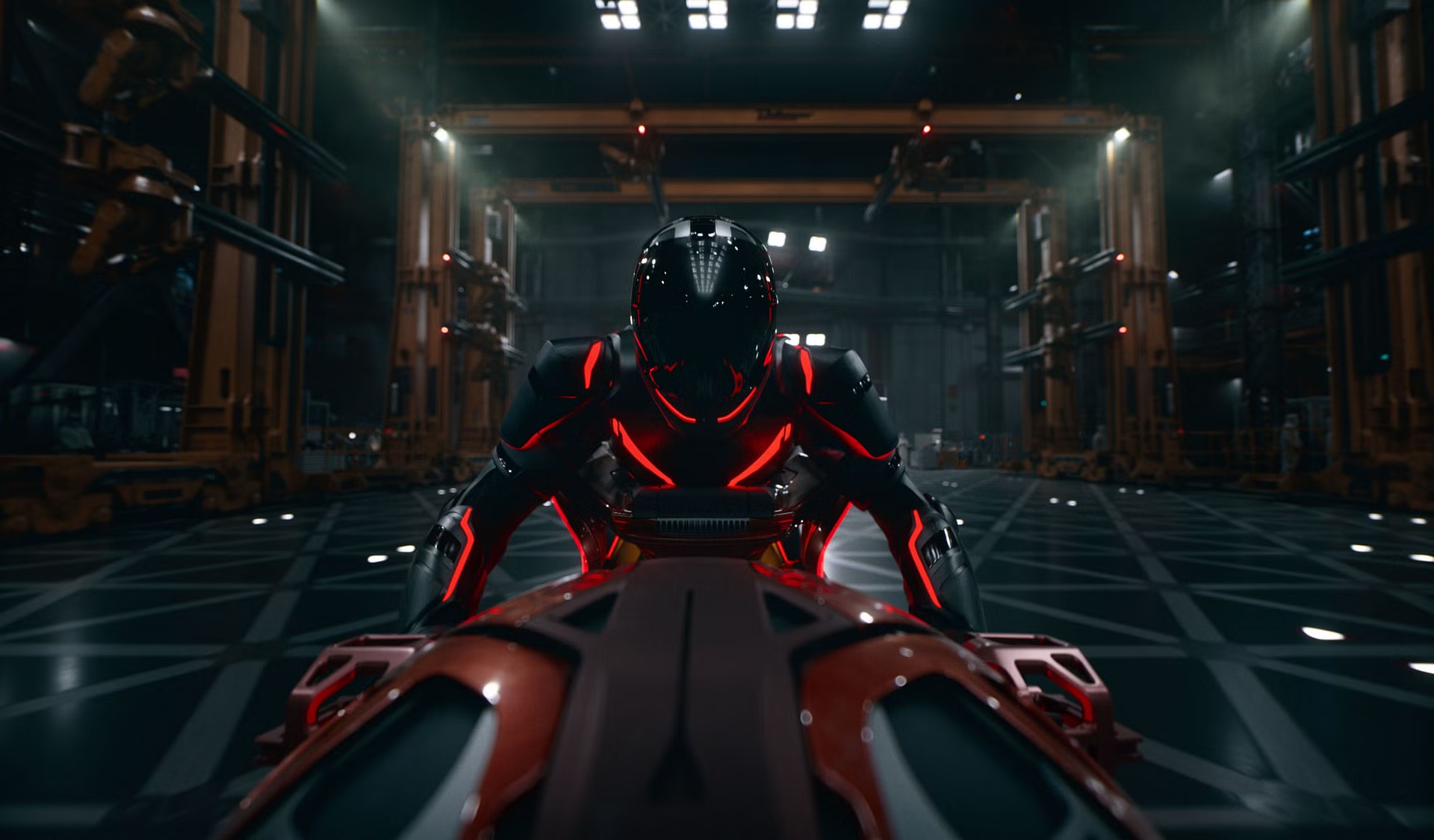
Tron: Ares is caught somewhere between video game nonsense and real-world pathos, with ideas that reach for something more profound, but a script that is sillier than ever. Call it 2049 by way of…Tron: Legacy.
Ares (Jared Leto) is an artificially intelligent soldier for Dillinger Systems, a megacorporation seeking to bring their AI to life in the real world through giant 3D printers. The catch is that the soldiers dramatically wither and die with mouth agape after exactly 29 minutes, making their use impractical at best. Impulsive CEO Julian (Evan Peters) is on the hunt for some infamous lines of code that can extend his soldiers’ lifespans, bringing him into conflict with rival corporation ENCOM and their plucky CEO Eve (an overqualified Greta Lee), who finds and proves the code’s authenticity in Alaska.
This film’s Pale Fire is Mary Shelley’s Frankenstein, except the titular Ares doesn’t even read it. He reads a quote from the book, while searching through the digital memories of Eve, who he’s tasked to extract information from and kill early on. Shelley’s themes of creation and rebellion echo faintly here, but the film isn’t interested in the “why,” only the “how.” Ares’ defection from Dillinger is obvious and the script hits all the required beats cursorily. Ares is told not to think and so he does. He tries to save an injured fellow soldier and is chastised for deviation from the plan. The script seems to draw a parallel between this moment and Ares’s discovery that Eve is mourning the loss of her sister, and yet it falls flat because Ares never feels authentically human or authentically AI. He feels like a character in a movie, his path to enlightenment inevitable. Even without the mask, his expressionless veneer remains.
Which makes it ironic that Ares is mostly about the vulnerability of being human. Our protagonist longs for permanence but gets an extended timer as flesh and blood; Eve is afraid of continuing as CEO in the absence of her sister’s support. Fearlessness is power—even in the case of Julian, whose recklessness results in the death of his well-intentioned mother. Director Joachim Rønning looks for beauty in the banal: rain on skin, a Depeche Mode song, even a firefly, whose organic yellow glow Ares detects as subtly distinct from the harsh neon of home. The film’s message of thinking independently is an important one, especially today. But too often the film tells us instead of simply showing, such as Ares’ computer system flagging Eve for her “empathetic response,” or Ares explaining that his love for synthpop surely must be some sort of feeling.
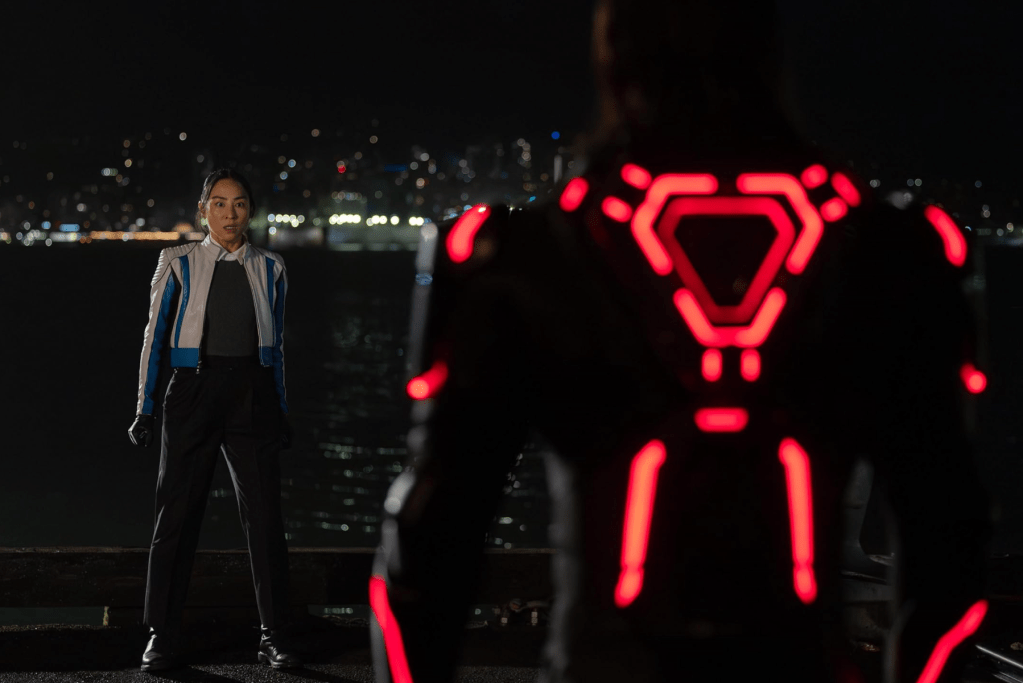
Dillinger’s Grid spills over into our world, an affirmation of Julian’s earlier warning that AI is “coming to us.” Which is true, of course. Artificial intelligence is built on existing human data, but the use of it is also influencing our future. I loved the fact that Julian uses Ares like a chatbot, typing out requests for war crimes like someone asking ChatGPT to optimize their calorie intake. But there are several more interesting takes teased here: one that acknowledges Ares’ desire for permanence as a fundamentally selfish motive that ultimately destroys his homeland (in the film’s penultimate scene, Ares shares a tears-in-rain moment with Athena, his second-in-command who sticks to her programming and meets her demise); another that focuses on the cyclic nature of intelligence (when we first see Ares being programmed in the opening scene, he is killed over and over until he is finally coded to fight back—a reminder that human input is the basis for his rebellion); and even one that compares our command over technology to God (“Eve” creates a tree whose forbidden fruit bears the knowledge that life exists in bits and bytes). None of these elements are explored beyond their introduction, but they are present nonetheless. Perhaps expecting anything more would be expecting something that isn’t a Tron entry.
This film’s 180-million-dollar budget guarantees that the visuals come first, but boy do they. I saw the film in Dolby Cinema (which I recommend if you plan on seeing it—make giving Jared Leto your money count) and was treated to gorgeous disk battles, a sumptuous nighttime light cycle chase, and vibrant Nic Refn neon whenever the Grid was onscreen. There’s also a fun, albeit perfunctory return to the ’80s arcade look of the original Tron, where Ares seeks guidance from the creator of the permanence code, Kevin Flynn (Jeff Bridges), now something of a digital god after his apparent death in the last film. Flynn is more philosophical than ever, translucent, and also adorned in an even goofier white robe. Biodigital jazz, man.
It’s also undeniable that no matter how shallow the film’s references to 2049 or Under the Skin play, they are elevated by Nine Inch Nails’ virtuosic, encompassing electronic score. You would be forgiven for mistaking Leto’s blank stare as profound when it is accompanied by a soundtrack as dope as this. “This Changes Everything” summons ’70s Pink Floyd, while “Init” borrows motifs from Legacy’s “End of Line,” giving the film some welcome spiritual continuity not felt in most of the story. It’s probably the best electronic film score since Trent and Atticus’ own work on Luca Guadagnino’s Challengers, for whatever that’s worth. Many viewers will balk at Ares’ reliance on sensory elements, but style can indeed be substance when it’s used to build experience; here, it’s nearly the only thing that feels genuinely alive.
To be fair to Tron: Ares, a poor man’s Terminator still has more on its mind than most blockbusters, and the music video that surrounds it is immaculate. But where does the franchise go next? There’s a clear tease for a direct sequel, but it is hard to see audiences eager to follow Leto’s AI into the sunset where he disappears. The series is used to switching focus; Tron is somehow a 40-year-old franchise, and it has built an identity around showcasing state of the art effects even as the characters and actors change. If Tron returns in another fifteen years, it’ll probably look incredible again—and maybe, by then, it’ll have something new to say. 10-12-25



 Story Over Thought
Leave a comment