
The sixteenth annual Eastern Oregon Film Festival is underway now in La Grande, Oregon. Nine feature films and 41 shorts are playing now both virtually and in person until October 18. EOFF 2025 features a diverse and unique lineup from both established filmmakers and exciting debutants, meaning there’s something here for everyone. If you can’t attend in person, I’d like to encourage my readers to check it all out here.
I was able to watch four of the festival’s feature films over the past two days, and in the interest of getting my thoughts out while the festival is ongoing, I have collected my mostly spoiler-free reviews below.
TRASH BABY (2025)
Gummo for the girlies, Jacy Mair’s neorealist Trash Baby wonders why anyone would bother taking care of themselves if they’re surrounded by garbage—literal and figurative. 12-year-old Stevie (Esther Harrison) lives in a hideously messy trailer with her parents and brother in the early 2000s. Everywhere you look, something has been shoved or dropped or tucked away, from pizza boxes to broken appliances to unwashed dishes. This general sense of disorder rears its head in the children’s behavior, as well. When Stevie’s brother realizes his ice cream cone is dripping during a trip to a local store, he simply smears it onto the floor.
One summer, Stevie crosses paths with Edie (Chloe Kramer), an alluring but mysterious 20-something-year-old who lets Stevie hang out with her and her friends. This initiation makes Stevie feel important; the first thing Edie does is paint her nails to match her own. But while the thrill of being accepted by others is satisfying, a lack of self-worth permeates the group. Edie and her white trash friends seem to only care about the here and now. Drinking, stealing, and acting beyond her years brings excitement and a tantalizing sense of identity to Stevie’s life, but gradually the story exposes the group as empty and directionless, paradoxically desperate to keep each other down. There is a great overhead shot of Stevie and her friends doing donuts in a car, in a great hurry to get absolutely nowhere.
Clearly inspired by Sean Baker, Mair does a nice job of capturing the pre-internet vibe of the early 2000s, where being a fan of something meant cutting a picture out of a magazine and using a glue stick to attach it to your door. Growing up today is a different experience entirely, one that is both documented and influenced by things like social media and streaming. We never meet anyone who lives outside of Stevie’s hometown, nor do we leave it, which results in her becoming disillusioned with nearly everyone in Pine Park. Is the apathy and cruel irreverence that surrounds Stevie the end of growing up, or holding her back?
The genius of Trash Baby, which premiered at SXSW 2025, is that it explores the complexities of adolescence without being supercilious to anyone; some of the bad influences in Stevie’s life are more sympathetic than one might expect, and the adults that she rebels against prove to understand the world more than she realized. Truth is independent of who is telling it, and oftentimes the messenger is the most messed-up of all.
WHEN THE MOON RETURNS/THE WORLD DROPS DEAD (2024)
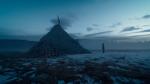
These are technically two distinct films, one feature and one short, but both are directed by Brandon Colvin and employ the same actors to explore similar thematic material. The animated short, which I watched first, functions as a sort of archetypal prelude, following a group of Druids as they sacrifice one of their own. The short is distinctly horror and has visceral, mythic imagery, such as a bestial Pagan god and gruesome ritualistic sacrifice. In other words, right up my alley.
The feature, which takes place in the modern day, focuses on the rippling effects of a Quaker man’s suicide—on his wife, his son, his church, but primarily on his daughter, Claire. Claire is disturbed by her father’s death and prays for reconciliation, for reunion. The two had similar personalities and a similar emptiness, implied in their only on-screen conversation. Compared to the short, which compresses a lot of story into a very short amount of time, The World Drops Dead is a simple tale told with funereal patience.
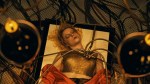
As displayed on the film’s poster, hands are a recurring visual motif. The churchgoers shake hands at the end of service. Claire reaches out to touch her father’s corpse; he reaches back within a dream sequence. In fact, the first shot we see is a shadow reaching towards a doorknob. In the subsequent scene (my favorite), Claire’s cat tries and fails to reach a book titled “The Silence of God.” It’s an evocative image, as even confirming the silence of God as intentional seems beyond our grasp.
The films effectively portray connection with the supernatural as both exhilarating and terrifying, using an alien green color palette and strange, otherworldly synths. Claire eventually makes a curious discovery that connects the two, which I won’t spoil here, but it leads to an Ordet-inspired climax that both provokes and confounds. On the one hand, the unusual imagery is striking. On the other, Claire and her father have so little dimension, and are so utterly defined by stillness and simplicity and death, that I felt a distance from the characters and events that was hard to shake.
Minimalism, repetition, and ultra-slow revelation constitute the Bressonian mode in which Colvin’s film operates, so those looking for more well-drawn characters or overt drama may be disappointed. The film prioritizes form above all, in hopes that the supernatural scenes pierce the void between Claire and her father, but also between audience and film.
AMERICAN COMIC (2025)
Like all great mockumentaries, Daniel J. Clark’s American Comic might as well be real. The film follows two up-and-coming stand-up comedians, Jay and Jovan (both played by Joe Kwaczala), who couldn’t be more different in style or political leanings. Jay is a Midwestern comic whose set leans heavily on conservative talking points, mostly making fun of the gays and the “woke mob” that he constantly reminds his fans is coming after them. He warns his followers that comedians can’t say what they want in America, but they can certainly push back by buying his Patreon. Jovan, meanwhile, is a bleeding-heart liberal obsessed with photoshoots who goes out of his way to identify with any marginalized group available. He feigns ADHD to boost his followers and develop new material; he performs at a queer-exclusive comedy show and accuses those who oppose him of “gatekeeping being gay.”
Despite these differences, the two display remarkably similar behavior in their personal lives. Both are incredibly narcissistic, show little concern for their friends and management, and have strange relationships with their fans (Jovan mostly uses his fame to pick up girls, while Jay can’t stand talking to the dense listeners of his podcast). Above all, the two are just generally obnoxious—but undeniably talented.
American Comic is laugh out loud funny, but the satirical element gets sharper and sharper as the film goes on. Like Rob Reiner’s This is Spinal Tap, our leads are hopelessly convinced of their own self-importance, and yet their impact is significant. A lot of what happens in the fictional verité-style doc is unrealistic or exaggerated, but the idea of using your voice as a brand is all too real. Both characters find success pandering to a crowd that’s eager to support one of their own, and this identity is both platform and prison; eventually Jay is forced to tour with a white nationalist, while Jovan deals with cancel culture after old YouTube videos are rediscovered.
The two stories eventually cross over, and the personas begin to crumble. To say anything else would divulge the third act twist, although you may have already guessed what’s already hidden in the title. You could say it’s predictable, but figuring out why grifters exist isn’t exactly a mystery. In fact, it’s kind of a joke.
THE OPENER (2024)
The Opener is a feel-good documentary about Philip Labes, a real-life singer-songwriter who was “discovered” by Jason Mraz on TikTok in 2021. Labes is invited to go on the road and tour with Mraz as COVID begins to wind down, and director Jeff Toye tags along to document Philip’s first time playing in front of massive crowds.
Labes is kind and talented, with a wide grin that seems to be his default expression. His music is heavily based around clever wordplay and simple chords, and his presence on stage is naturally funny and energetic. And while he is not an especially interesting subject for a documentary, his simplicity is appealing. Labes understands that luck was involved in his opportunity and spends much of the film thanking others or deflecting credit (he even performs in a plain white T-shirt covered with messages and signatures of his fans). He talks about his family having vague “financial struggles,” but has a good relationship with his parents and inspires his father to post music online as well. He admits that he felt sad during lockdown, and that maybe it’s okay to feel sad—but he would prefer to be happy, of course.
The film tries to tie everything into COVID and a general theme of coming together, and it makes for a light and easy watch. The “antagonist” in the film isn’t people, but events and circumstances out of our control. Like many post-pandemic documentaries and retrospectives, it frames connection as healing and essential. The Opener‘s big climax involves Labes trying to outwit Mother Nature herself when a concert is rained out. Dream or delusion? Does it matter?
Special thanks to filmmaker H. Nelson Tracey and the EOFF team for making coverage possible.

 Story Over Thought
Leave a comment