
Talking about Shelby Oaks, the debut feature of film critic and YouTuber Chris Stuckmann, is more fun than watching it. As an aspiring film critic in my mid-twenties, I’m not only a fan of Stuckmann but someone he directly inspired. I love listening to Chris talk about his film, and seeing his name on a movie poster at my local theater feels like watching a friend succeed. Not only is this a feel-good story that can affirm belief in the power of chasing after what you love, but it’s also undeniable proof that the indie filmmaking world has changed forever. Stuckmann couldn’t even get approved as a critic on Rotten Tomatoes years ago. Now there are hundreds of “professional” critics reviewing his film, thanks to donations from his fans, distribution from Neon, and the promise of getting “Stuckmannized” on the big screen.
But while Shelby Oaks may rank near the top of projects from YouTube-critics-turned-filmmakers (is there such a trend? What’s RalphTheMovieMaker doing these days?), it’s also true that Stuckmann’s knowledge of films and the way they work does not necessarily equate to experience making them. This fact is not immediately apparent; the film looks professional and is competently shot. Performances are solid across the board, and the production even secured a score by the Newton brothers (albeit one that feels far too overwrought and generic). But the story being told here—a highly derivative pastiche of films like Blair Witch, Twin Peaks, Lake Mungo, Rosemary’s Baby and Hereditary—is where flavor and craft are most lacking.
The story begins with a strong hook. The opening 20 minutes, an extended section from a mockumentary exploring the disappearance of paranormal investigator Riley Brennan, features unsettling, grainy videos in an eerie found-footage style. But the bulk of Shelby Oaks, which follows Riley’s sister Mia in the present day, is predictable and pedestrian. Mia is visited by a suicidal man holding a tape that contains new footage of Riley’s apparent kidnapping. She visits the local library to conduct research, interviews a prison warden who provides some chilling details about the man who delivered the tape, and eventually discovers a book belonging to Riley filled with demonic symbols and imagery. By the end of Mia’s investigation, there is zero mystery or ambiguity left—the antithesis of what makes found footage interesting. In a better film, one that expands on the opening’s focus on speculation and misinformation concerning the disappearance of a content creator, that could be the point.
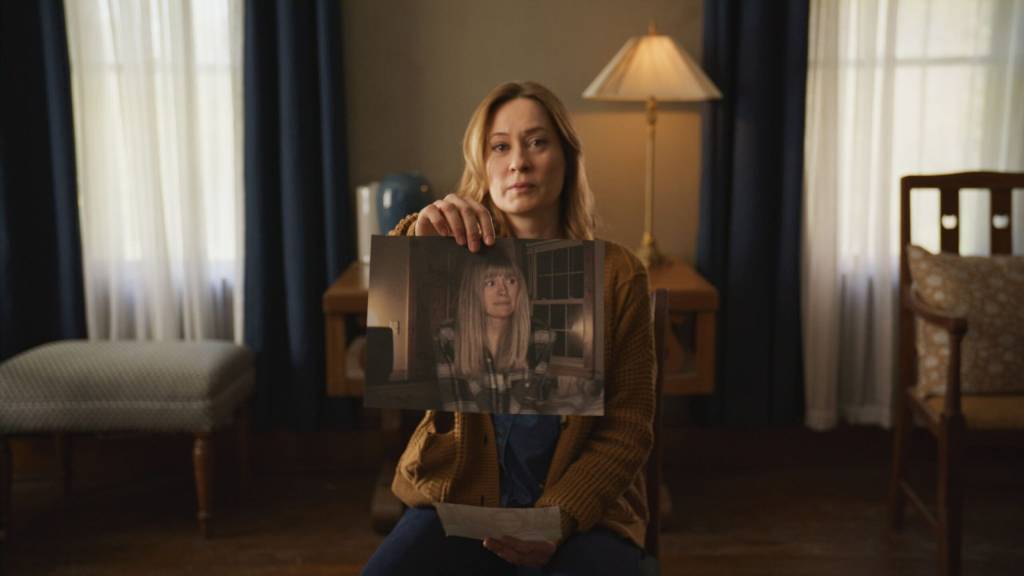
The second half is weighed down by questions common to the horror genre, such as why Riley wouldn’t turn this tape over to the police, why she would visit a haunted prison in the middle of the night while alone, why a family of Satan (sorry, Incubus) worshipping kidnappers would keep a photobook documenting their deeds, or why said family would elude questioning from the police even though Mia finds them the moment she arrives in town. As we all know, the truth is that none of these nitpicks would matter if the central mystery were more gripping. Mia’s journey, which consists mostly of wandering around with a distressed expression, is a slow burn without much cooking. It gave me too much time to think, mostly about how I’ve seen so many of these tropes before. Despite all of these complaints, Stuckmann does swing big at the end, with a downbeat, anti-nostalgia ending that feels out of place in a good way.
It’s important to remember that Shelby Oaks was never intended for a wide release, with significant reshoots occurring after Neon doubled the budget. Stuckmann himself has said the initial expectation was to post the film to his YouTube channel, or at best, have it picked up by a streaming service like Tubi. With that in mind, this is a movie that can best be appreciated as an appetizer for better things to come.
One of Stuckmann’s more polarizing traits is that he has stopped posting negative reviews on his channel in recent years, a response to understanding just how difficult filmmaking is. Some have accused this move of anticipating accusations of hypocrisy, but I think that’s unfair. Like Stuckmann, I’ve made my own shorts for years and know all too well that good taste and good intentions mean nothing without the skill to bring the vision in your head to life. It’s my hope that good film criticism can recognize both simultaneously. Shelby Oaks is, unfortunately, a fitting example. 10-26-25
 Story Over Thought
Leave a comment