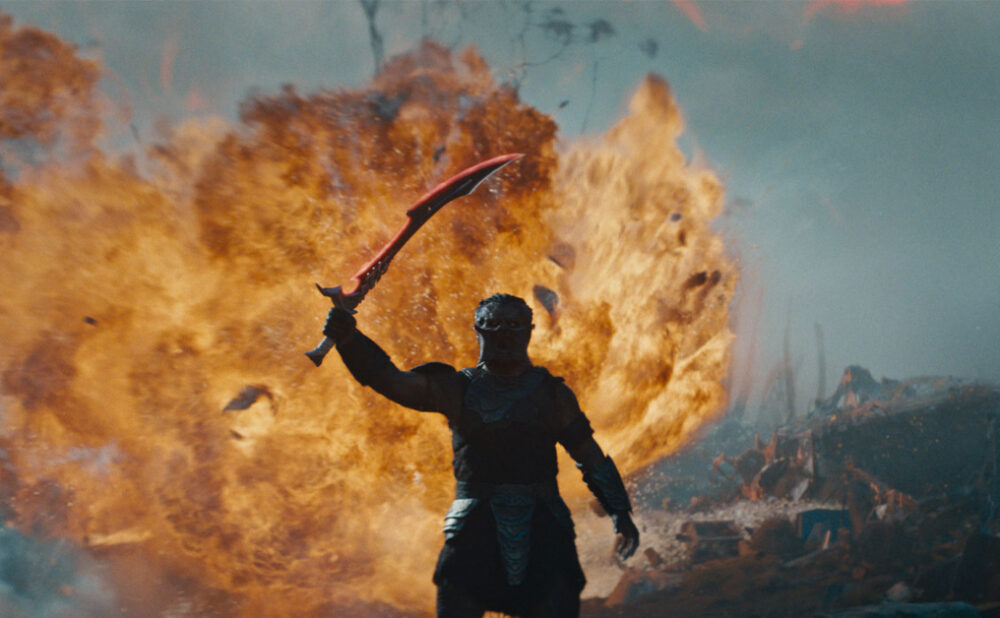
Hollywood loves its antiheroes, and after nearly 40 years of entries, it is finally time for the Predator franchise to follow suit. That’s right—there is nary a human in sight in Dan Trachtenberg’s Predator: Badlands, which focuses on a Yautja warrior as he attempts to survive the deadliest hunting trip imaginable. How do you make the world’s most lethal killing machine relatable? By putting him on a planet where the grass is shards of glass. Ouch!
It’s no accident that Badlands shares its title with a Terrence Malick film that explores the darker side of romanticizing the outlaw life. Like the Malick film, this one is also about individuals being controlled—only in this case, the control comes from inherited, coercive familial influence. Our protagonist, Dek (Dimitrius Schuster-Koloamatangi), is warped by the warmongering spirit that dominates the Yautja tribe. At the beginning of the film, we watch him and his brother fight nearly to the death, only to learn that they are simply having fun. Moments later, Dek watches the same brother be executed for showing mercy—and by their father, no less, after he deems Dek a runt and orders him killed. This act saves Dek’s life but also forces him to flee his home planet, hardening him further. When our Predator travels to the “death planet” Genna to add the ultimate scalp to his resume (the unkillable Kallisk, a giant cat-like monster that can regenerate limbs), it is for glory and pride, but, more practically, the only way he will be welcomed back into the clan.
For Dek, the entire world is either prey or a nuisance, even those who assist him. He thinks he is using the wounded android Thia (Elle Fanning) as a tool on his hunt (by both referring to her as such and using her as a literal GPS). However, it is revealed halfway through that she has equally used Dek to find her legs (ripped off in a battle with the Kallisk) and so that she can contact the rest of Weyland-Yutani (!), a corporation interested in capturing both Kallisk and Predator alike.
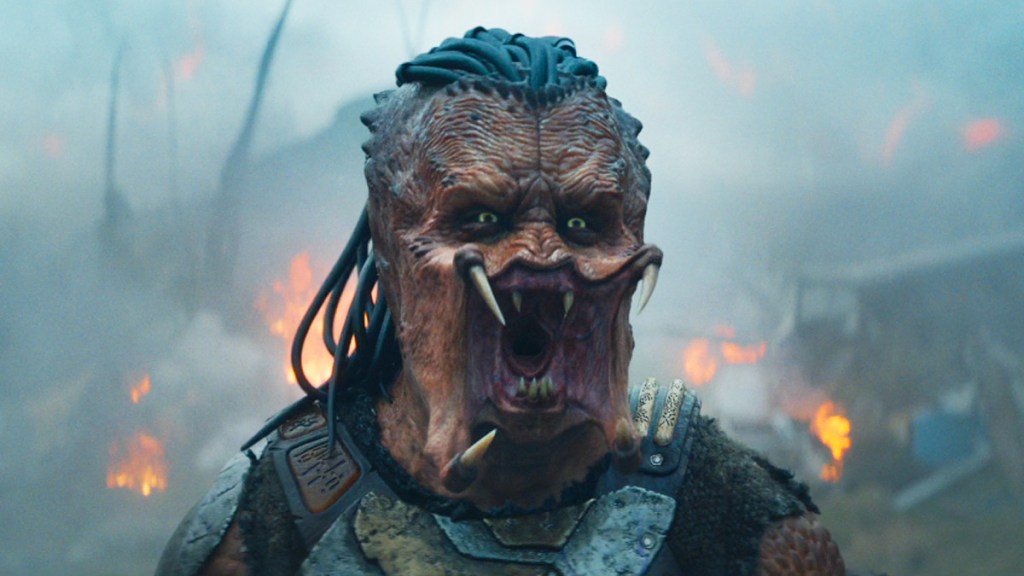
Thia, too, has performed her own mental gymnastics, since Dek helped her under false pretenses—albeit unwillingly—and her “sister” Tessa (also synthetic, and also Elle Fanning) chastises her for showing empathy, reminding her that the mission comes first. We learn that Thia’s empathy was coded into her specifically to take advantage of anyone who could prove useful on Genna, and Tessa decides that she is malfunctioning if these feelings persist after the hunt is over, so to speak. This hubris mirrors the portrayal of the Yautja in the first act.
Not only does this familial influence reflect Dek’s experience, but it also invites an interesting psychosexual reading of this mutual instrumentalization. Dek is young, brash, ultra-masculine, and views the feminine as an annoying but necessary accomplice in getting what he wants, while Thia feigns servitude to profit from his selfishness. Rather than being inherent, these views are encouraged and reinforced by the figures of authority around them.
After being betrayed, Dek battles the Kallisk to collect his trophy anyway. He is soundly defeated and only spared after the beast recognizes the scent of her child, who helped Dek and Thia earlier in the film. Dek is captured by Tessa only to be freed by Thia in an act of radical empathy. Now aware that even the, ahem, ultimate predator cannot survive on its own for long, Dek decides Weyland-Yutani is the real villain and repays the favor by returning to free Thia, who was decommissioned for repair. After acknowledging that they’ve been misled, Dek and Thia team up to defend the Kallisk and her child. This “found family” transcends manipulation and inherited bias, forging a genuine connection.
Humanizing the Predator is a tough line to walk, and the film occasionally feels too cute and pat—even when it ends with the protagonist killing his own father. It is, after all, a literal Disney movie: one with sidekicks, feel-good character arcs, and a big CGI battle in the finale (although it admirably maintains scale and a semblance of believability). Still, I would rather see a film take a page from Fury Road and explore gender dynamics instead of indulging in the usual self-aggrandizing isolation. Or one that also mirrors that film’s pace and style. Badlands is often a superb action film, with weighty, physical performances from the two leads and tasteful CGI that never feels explicitly manufactured—a minor miracle in its own right.
Speaking of the effects, anyone turned off by the PG-13 rating need have no worries. Badlands is extraordinarily violent, with dismemberments, eviscerations, and gruesome crushing of heads, all deemed suitable for a younger audience since the blood is alien green and the violence in question is inflicted on robots instead of humans. What was I just saying about the paradoxical nature of a film like this? Can we have the MPAA investigated, please?
Anyway, Trachtenberg has somehow made three good Predator films in a row, arguably improving with each entry. There’s something a little ironic about a corporate, franchise nostalgia film pointing out that being spoon-fed the same thing over and over is the real enemy, but even I have to shut up at some point and enjoy the cool, thoughtful action movie for…well, being cool and thoughtful. 11-19-25



 Story Over Thought
Leave a comment