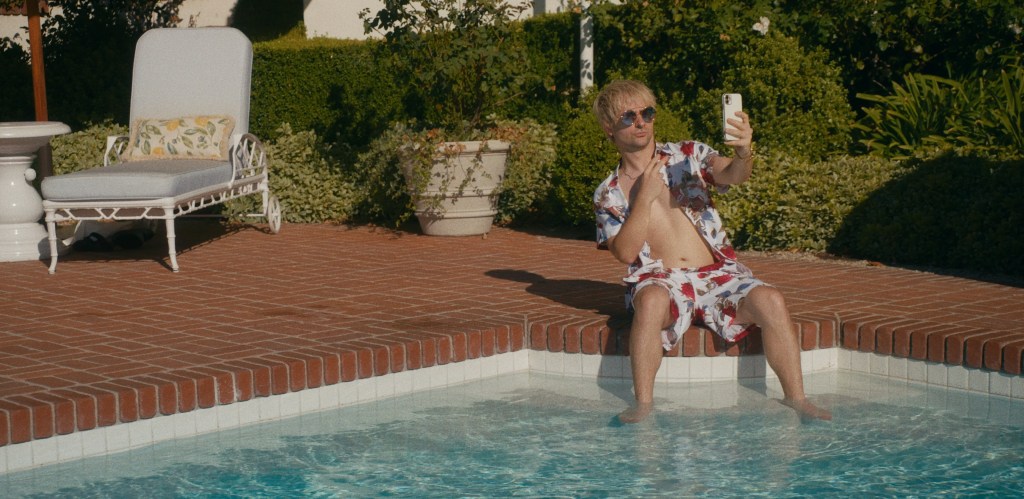
Few movies released this year seem as culturally timely as Daniel J. Clark’s American Comic, a mockumentary about two up-and-coming comedians who have more in common than what initially meets the eye. And while the film has a thoughtful take on comedy’s role in society, it’s also hilarious, a praise that all too often can’t actually be said of something trying to simultaneously appeal to the prefrontal cortex.
Writer/star and actual comedian Joe Kwaczala and Emmy-nominated director Daniel J. Clark were both gracious enough to talk a little about their award-winning movie in an exclusive interview on themes, influences, and the unique production. My questions are in bold.
First off, congratulations to both of you on the film. Joe, American Comic centers on the stand-up scene but clearly has a lot to say about American culture beyond comedy. As a writer, what made stand-up a compelling vehicle for that satire?
JOE: I guess it goes back to the old adage “Write what you know.” I’ve been a stand-up comedian for more than 15 years, so I’ve accumulated so many stories, encounters, incidents, nightmares, you name it. I’ve spent so much time with comedians, who are some of the most psychotic people on earth. And yet, a lot of the movies and TV shows about stand-up tend to mythologize it with extreme reverence. So not only did I feel like I had the lived-in experience to properly satirize that world, but it felt like that angle was still fresh. Comedians will try to convince you that they’re “modern-day philosophers” but it’s my mission to push back against that.
There’s a clever structure to the script that keeps the audience guessing. What was the writing process like, especially knowing you’d ultimately be performing what you wrote? Had you written a feature-length script before?
JOE: This was my first feature-length script, but because I knew we were going to make it, it didn’t feel like what I had always imagined “writing a screenplay” would be like. At first, I was just jotting ideas down into a Google doc, and then those ideas became scenes. It was kind of like a puzzle to arrange the scenes in a way that gave the story shape, and then I’d add things that I felt were missing, like an ending or additional characters.
Probably the most challenging thing was knowing I’d be playing multiple roles. I had to flesh out two characters who were distinctly different but still within my range as an actor.
Daniel, you previously made a documentary about Flat Earthers that was praised for its empathy toward its subjects. Did that experience influence how you approached telling a story about people who intentionally mislead others for money or fame?
DANIEL: The fact that people give praise for Behind the Curve’s empathetic approach is really great, but I’ll be honest, surprising. The way I approach documentaries is to really understand the subjects and who they are. Empathy is implicit in how I work. So yes, the same is certainly true with American Comic. Although, I would say, I was much more free in this film to really have the characters look foolish or disgusting–something I would never do if I was working with a real person.

You’ve primarily been a documentary filmmaker, but this is a mockumentary with a traditional narrative underneath it. How similar was the filmmaking process to your documentary work? I read that many of the stand-up scenes were shot in front of real audiences on real stages. Was there rehearsing, reshoots, or material you ended up cutting in post?
DANIEL: The best compliment I can receive from people who see American Comic is that they didn’t realize it was a fake documentary. It was also, in many ways, easier than making a normal narrative film. But that’s not to say there weren’t challenges; they were just different. We had time to rehearse, block scenes with actors, do multiple takes, and redo anything that didn’t work exactly right. However, I was really careful to try to never let it feel like we weren’t capturing something in-the-moment. The camera jostles, it’s following the dialogue and not anticipating any responses, never leading the movement of anything that’s happening.
We did, indeed, film at real shows with unsuspecting audiences. Joe was introduced on a show as his character, and the audience just thought he was some guy. If we didn’t get exactly what we needed or if the audience didn’t react right (or if I messed up something with the camera or sound!), we’d have to do another show somewhere else to get it right. This was a huge challenge especially for Joe who had to make these audiences laugh and nail the delivery in order to get what we needed for the story. But what’s really crazy about that is Joe would have to do 5-10 minute sets in-character just to get the one usable line. So he really worked hard to make good standup sets that were in the voices of these characters. It’s a lot of pressure, but Joe made it work every time.
We had a lot of extra material that never made the final cut. Probably about 30 minutes worth of story or extra scenes. I’m excited to show them to people as DVD extras or whatever because they’re well written, acted, and shot; they just didn’t work for the story.
What were some of your influences on this film—movies or otherwise?
DANIEL: The film influences for American Comic might be pretty apparent. They are the famous mockumentaries and documentaries of our time: American Movie (our title is an homage to this, really), This is Spinal Tap, Comedian, King of Kong, and so many more.
JOE: And as for the characters I play, I am drawing from probably like 100 or so comedians I know who have said and done things that are very similar to what you see in the film. I think one thing that might surprise people is that the behavior displayed by my characters is not really an exaggeration. Comedians are so weird!
What do you hope audiences take away from American Comic once it’s over?
DANIEL: My hope is that people are able to see through a lot of the bad comedy that’s out there and see the inauthentic personalities for what they are. Then clear the way for the truly great, odd, and straight-up funny people who have a good-faith desire to make audiences laugh.
JOE: I think I’d like this to be a reminder of where comedians ought to be in our culture. I feel like there are a lot of forces right now that are exalting comedians to this unrealistic tier of influence and power, and that’s worrisome. Comedy will not save us, and the only thing we should trust comedians with is their ability to make us laugh. And that’s perfectly fine!
American Comic is currently screening on the festival circuit. You can read more about the film and check for showings here. 12-2-25


 Story Over Thought
Leave a comment