
If ever there were a film destined to live on through video essays and wordy Letterboxd reappraisals, it would be Joker: Folie à Deux, which is simultaneously the most boring and ambitious comic book movie in recent memory. In some weird way, this movie was always made to be talked about in hindsight, removed from the weekend where supporting the film required actually showing up to the theater and buying a ticket.
You’ve likely read it before: whereas the first film was somewhat pro-Fleck but widely interpreted as pro-Joker, this movie explores why that (mis)interpretation made Todd Phillips and company so much money. Folie à Deux (a title not referring to Arthur and Harley, but to Arthur’s relationship with the Joker) dares the audience to root for Arthur without the presence of his alluring persona. He attracts the admiration of Lee, but only as larger-than-life villain, not the pathetic loser underneath. Similarly, Arthur’s fans give him the recognition he craves because of his madness, not in spite of it. Sound familiar?
By exploring a Joker who is actually sympathetic, and by stripping the power fantasy of both power and violence, the film completely alienates the fanboys with Heath Ledger posters on their walls. I have nothing but respect for that choice, and I have nothing but respect for a filmmaker who hates their audience IF they are also trying to make some sort of point. This is a film that ends with Fleck’s Joker being unceremoniously stabbed to death by a character serving as homage to the “classic” Joker, a perfect ending that is quite possibly the worst ending imaginable if you’re not keyed into what Phillips is trying to say about society’s appetite for spectacle.
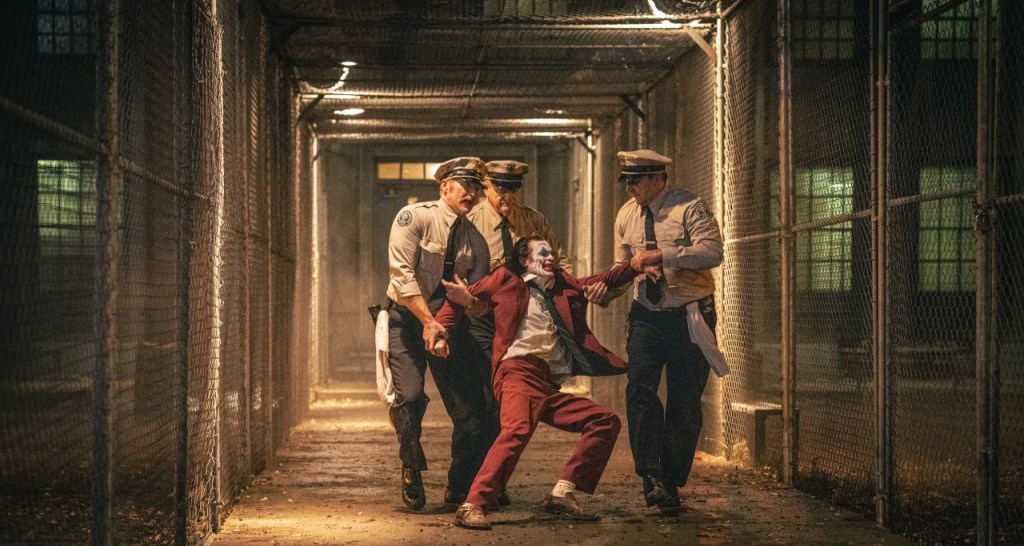
Unfortunately, there are plenty of maddening decisions here as well, such as hiring Lady Gaga but making a jukebox musical, or setting an interrogation of the Joker “identity” in a literal courtroom where characters from the first film talk at length about things we already know. That’s the problem with making a movie designed to piss off the viewer: you still have to deliver something sweet that mixes the medicine in, lest they get angry at the fact that they paid money to get trolled. The courtroom drama and musical numbers were no doubt intended to do this, but both feel repetitive and either dramatically or visually flat, which is a real shame given the talent involved and the script’s brazen ideas.
It sucks because Phillips doesn’t really deserve the backlash he has received for either film, at least in my opinion. What’s most confounding is that separating Fleck and the Joker has drawn the ire of critics accusing him of pandering to incels again; as if portraying the mentally ill as anything other than a psychotic force of pure evil is another example of white men claiming the victim card. When in reality, most of the white male Joker fanbase would have preferred seeing pure evil do its thing. The irony. 12-9-25



 Story Over Thought
Leave a comment