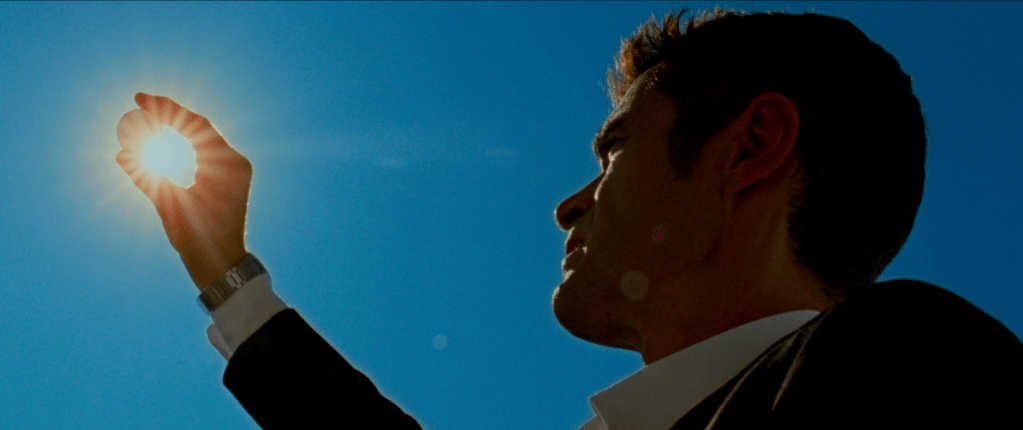
You have to wonder how often French filmmakers Hélène Cattet and Bruno Forzani hear that their work is “style over substance.” That phrase has long been used (perhaps justifiably) to critique movies with more visual style than narrative depth, but, unfortunately, just as often to describe intentionally opaque and hallucinatory works of art. How anyone can glean meaning from a story that’s hard to understand is a valid concern—but the real question is whether the confusion is intentional, and if so, what that choice is meant to accomplish.
Admittedly, the plot for the couple’s new James Bond pastiche/homage is hard to describe. Former spy John (Fabio Testi) is living out his final days on a luxurious resort in the French Riviera, but after a woman is murdered, he begins to think villains from his past are coming back to haunt him. We cut back and forth between older John and his younger self (Yannick Renier) as he chases the elusive Serpentik, a mysterious femme fatale who might be more supernatural than human. But are these legitimate memories, or the fevered recollections of a dying man? Cattet and Forzani have attributed the present-day singular location and central theme of obsession to Death in Venice, which clarifies what this movie is trying to do with Bond.
As I alluded to, the duo has always made highly experimental films that deconstruct and disorient in equal measure (giallo-inspired The Strange Colour of Your Body’s Tears is a favorite of mine). Reflection follows suit by taking the characters and setting of a spy flick and dropping them into a dreamy, fractured loop that feels far more like Last Year at Marienbad than Thunderball. As plot points dissolve into abstractions, it becomes tough to tell when John’s mission begins, when it ends, or what his goal ever truly was.
A massive wrench is thrown into Reflection halfway through when it is revealed that John might actually be a former movie star who is confusing his roles with his real-life past. His car doesn’t actually have a turret; the diamonds he kept from his adventures are fake. However, John also remembers being briefed on a nemesis named Kinetic, who hypnotizes his victims into believing they’re in a film, casting doubt on his entire memory. You would be forgiven for giving your own arm a quick pinch here, just to confirm anything as actually real.
According to the filmmakers, the film’s structure is written to resemble a diamond. Cattet and Forzani, heavily influenced by the works of Satoshi Kon (especially Millennium Actress), have designed the script to take on a new interpretation depending on what you choose to focus on. If you take the events literally, then it is likely a story of a superspy realizing they’ve been duped and returning to save the world. Another equally rational explanation is that the film is an incomprehensible death dream from a septuagenarian who likely has dementia. Most obviously, of course, this is a movie about a man simultaneously haunted by and obsessed with the women he has used and abused.
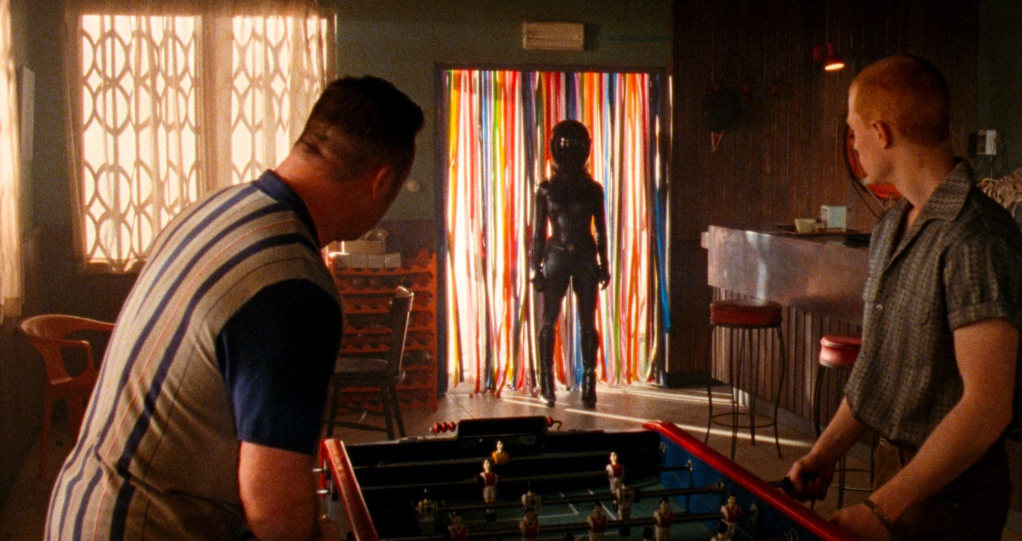
As in actual Connery-era Bond films, we see younger John sadistically torture women for information. Serpentik’s role in the story isn’t especially subtle; her skintight black bodysuit and heels, which contain a hidden blade, evoke a mysterious dominatrix that John is both repelled by and drawn to. In a fun riff on Mission: Impossible, John unmasks her over and over only to see a new face each time, as if Serpentik is an amalgamation of all the women he has scorned. In the “present,” the mystery girl’s murder is what sparks this crazed reflection for our protagonist. Is the actor angle a way to deal with his guilt? Or was he an actual actor fired for getting in trouble offscreen? A wild third act incorporates comic-book panels, actors dubbing over scenes as we watch them, and our protagonist being replaced by a new performer. The past rarely matches how we remember it.
Even as answers continue to slip through our fingers after the credits roll, failing to connect the details didn’t keep me from getting my socks knocked off. Cattet and Forzani have made a spy thriller that is abstract and elliptical, but crucially, a feast for the eyes and ears. Even without the comic-book panels, the film would still often resemble one. There is a striking intensity that results from the film’s frequent use of close-ups, and you can’t watch more than five minutes without bearing witness to bizarre, evocative imagery (a dress made of a hundred tiny cameras), kaleidoscopic montage (the stylized Bond-inspired credits sequence), retro needle drops, or pop-art surrealism. Maybe the biggest surprise is that the film also has legitimate action, something most experimental thrillers have no interest in.
It is only natural to compare this approach to Tarantino, but anyone familiar with both will realize the two are subtly very different. Where Tarantino remixes his influences into a modern narrative drenched in ironic humor, Cattet and Forzani are imitating more sincerely. Instead of breaking the illusion by winking at the audience, their films inhabit the grammar of the genres they reference. Any homage often feels eerily close to watching the real thing. Still, while the style exuded here could be individually traced to any number of psychedelic European Bond knockoffs or Italian deep cuts, it is just as easily comparable to more popular films; there are Kubrickian zooms, roaming and hypnotic shots of black and white tile à la Twin Peaks, and a hyperreal, vibrant color palette that Argento would be proud of. And if not a direct influence, only Refn could fully appreciate placing the squeaking of Serpentik’s rubber so high in the mix.
Whether these styles coalesce into a satisfying experience is up to you, but I can’t wait to see what’s next from two of cinema’s most exciting filmmakers. Cinema is one of the few art forms where visuals and sound can be fused with total control; criticizing it for not resembling literature seems shortsighted. And not only does this attitude strip cinema of its power to have an effect beyond the cerebral, but it also shows a lack of imagination. We’ve had 27 James Bond films over the years. You would be hard-pressed to find any of them as memorable as experiencing Reflection in a Dead Diamond. 12-10-25


 Story Over Thought
Leave a comment