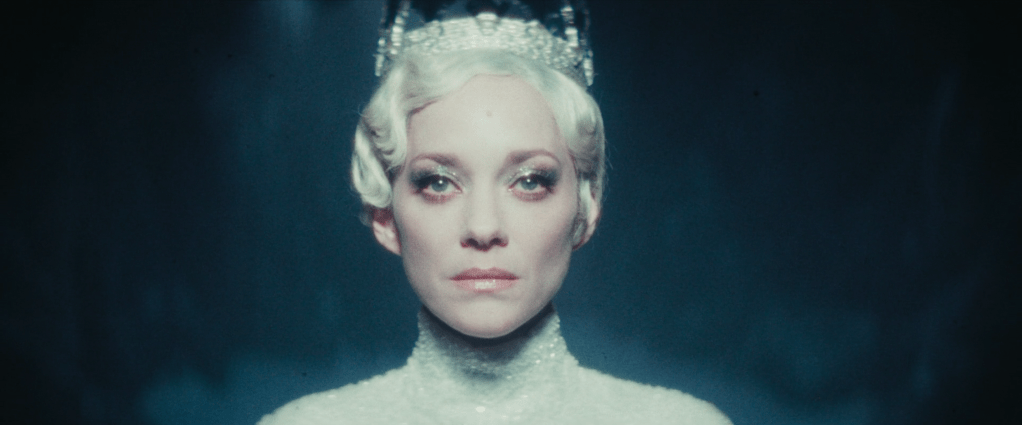
Lucile Hadžihalilović’s stunning and wintry fantasy drama The Ice Tower casts a transfixing spell. It’s a movie about shutting your heart off that does the same to the viewer for a little while, as the glacial pacing makes it difficult to devote your full attention. And to be frank, it never picks up speed, which will be a major turn-off for many. But if you’re patient, there is a strange and darkly beautiful fairy tale to be drawn into here, achieved not only through the lavish, surreal production design and film-within-a-film dreaminess, but perhaps most of all through the performances.
Jeanne (Claira Pacini) is a runaway orphan in the seventies who is sleeping on a film set when she catches a glimpse of the gorgeous Cristina (Marion Cotillard), an actress playing The Snow Queen in a film adaptation of the titular fairy tale. Jeanne, already well acquainted with the story, is immediately drawn to the intense independence Cristina radiates and becomes infatuated with her. After managing to get hired as an extra on the set, the two form an unlikely but chilly connection.
The young and awkward Jeanne is at a crucial point in her self-development, looking for someone to model herself on in a world where she doesn’t belong. But while Cristina is beautiful and alluring, she is also distant and self-obsessed. The actress mistreats her co-stars, throws fits when the production runs into issues, and is cruel to Jeanne even as she invites her into her world, often referring to her as a “rat” or making unfavorable comparisons to herself.
Early on, Jeanne watches a girl skate flawlessly in a public ice rink. When she tries to talk to the girl afterwards, she is mostly brushed off. Not only does this scene foreshadow the ending, but it also leads to Jeanne stealing the girl’s purse and pretending to be her on the set. Theft is a recurring theme in the film, used to explore the almost predatory nature of identity—how we take from others to sustain ourselves. Jeanne steals a jewel from the Queen’s costume; Cristina steals beads that belonged to Jeanne’s late mother.
Hadžihalilović finds several ways to mirror Jeanne and Cristina and their troubled pasts, perhaps initially the same life at different points: Jeanne marvels at the idea of having your photo taken for a magazine, while Cristina no longer cares; Jeanne is struck by the beauty and glamour of the film set, while Cristina sees it as an annoyance. We learn that the younger actress admires Cristina’s character because she is immortal. “But she’s alone,” warns the Queen.
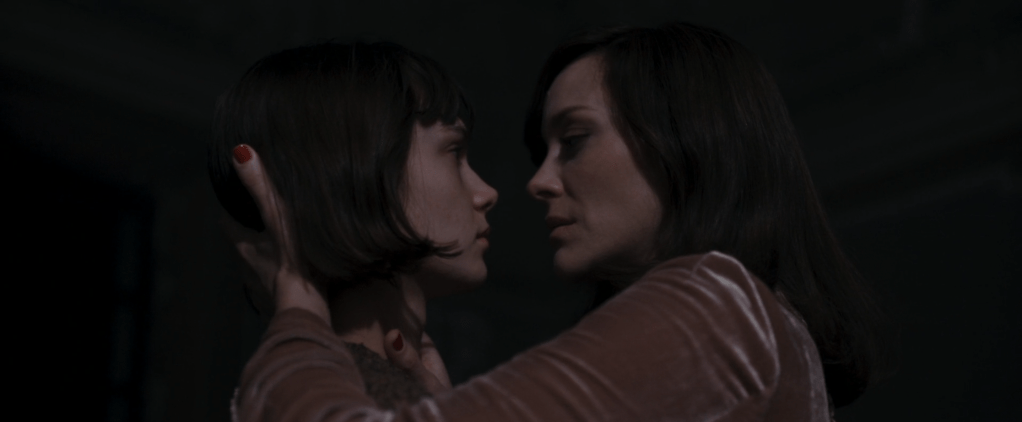
Hadžihalilović’s exploration of idols grows darker and darker as it progresses, incorporating drug addiction, suicidal ideation, and obsession pushed to the brink. Jeanne is searching for someone to provide the warmth her mother once did, before she overdosed when she was six. But the star sees their relationship in a much colder light. The film culminates in a scene of shocking sexual assault, where Cristina’s violent advances on Jeanne are comparable to a vampire trying to suck the soul out of its prey. While Cristina may once have been like Jeanne, simply seeking to ease her pain by turning inward, she is now locked inside the Ice Queen’s tower. With her soul eroded to the point where she can only reciprocate corruption.
As I mentioned, The Ice Tower develops at an undeniably measured pace—especially in its first half hour—even for viewers like me who are usually willing to extend some patience. But there is some method to this early lack of madness. Cristina and the production stand in stark contrast to the earlier scenes of Jeanne’s dull life at the foster home, so that even as the warning signs begin to pile up, we also can’t help but feel drawn to Cotillard’s demanding presence, especially as the growing sense of unreality and crystalline terror of Hadžihalilović’s vision keep us engaged.
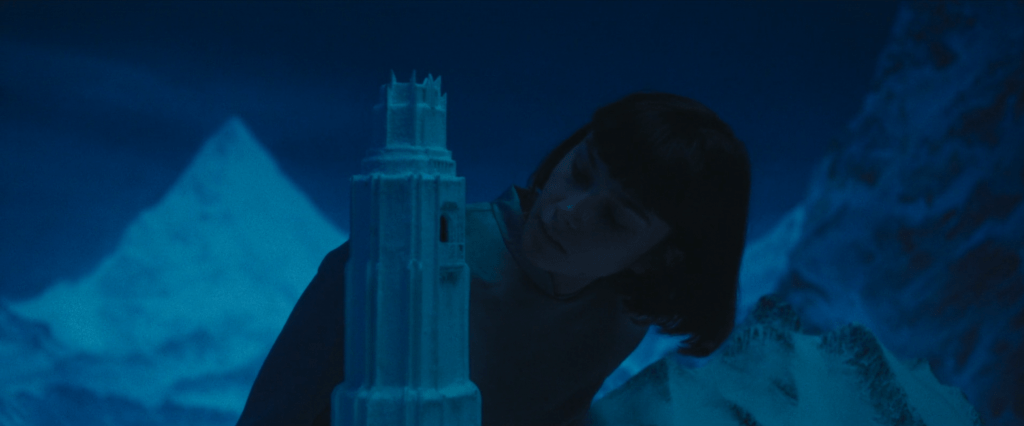
This movie has a lot in common with another film released last year, Reflection in a Dead Diamond, which also explored actors and identity, and also used crystals as a symbol. Whereas that film examined the self in a more meta sense, Hadžihalilović’s film uses the crystal to analogize Jeanne’s coming-of-age. As the opening reflections explore, certain paths are initially shrouded in mystery, dark and cold but strange and intriguing. At the end, this technique is used again, but now the visions are bathed in sunlight, reflecting Jeanne’s realization of where this isolation leads. As the last line of the narration explains, Jeanne has seen “the Queen’s realm in all its glory. And even better, within this crystal, one could see a thousand other realms.”
Much like Lynch, the film’s more surreal sequences don’t offer explicit answers to the question of whether they’re “real,” because the association is what’s paramount. See a scene where Jeanne devours a crow (another recurring motif) for the camera, or a subsequent one in which Cristina removes the blood from her mouth with a kiss. Hadžihalilović’s film, ultimately, does not descend into surrealism but uses these visions to deliver a sequence of crushing reality at the end.
I spend most of my time writing about narrative, but the truth is that the two leads equally deserve credit. Cotillard (who also starred in Hadžihalilović’s 2004 debut Innocence) fully dedicates herself to the tragedy required in such an unforgiving role. And Pacini, making her feature-film debut here, is believably vulnerable yet reveals a quiet strength in key moments. There’s also much praise to be lent to Jonathan Ricquebourg’s striking cinematography, especially in the dream sequences that blur the set with the mythic imagery of Anderson’s story, and composer Rosa Lukens’ dissonant, minimalist score.
I admire this movie more and more the more I think about it. Like the best fairy tales, The Ice Tower weaves beauty and terror together masterfully, feelings that are, unfortunately, often synonymous with growing up. 1-4-26


 Story Over Thought
Leave a comment