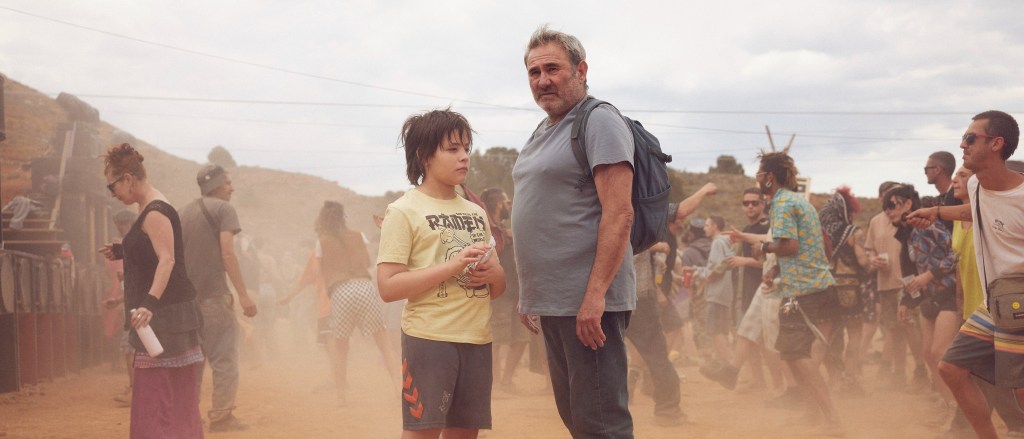
In a rare act of conscientiousness, I’m going to refrain from spoiling a crucial scene halfway through Óliver Laxe’s Sirāt. Given my penchant for (attempting) analysis in the hybrid reviews on this blog, that might seem surprising, as virtually every post on the site treats plot points with the discretion of a celebrity tryst. But I don’t want to ruin this experience for anyone, especially those even vaguely interested in seeing it. When Sirāt releases next month in North America, I recommend going in as blind as possible. In fact, I probably wouldn’t read this review at all.
Of course, you can also let curiosity get the better of you. Put simply, Sirāt is a strange, increasingly horrifying techno-scored Wages of Fear that may involve the literal end of the world. At the beginning of this film, the military’s sudden arrival at and subsequent dissolution of a Moroccan rave results in the formation of an unlikely alliance: a group of ravers living a life of hedonistic detachment on the way to the next show, and a father/son duo propelled by purpose in their search for a missing family member.
Laxe’s film is obsessed with EDM and its shamanic properties. The opening scene follows the organizers of an (illegal) rave as they carefully set up the sound system, and the camera focuses on the individual speakers, which gradually exude a steady hum. The speaker becomes a recurring image, sometimes appearing without context. At one point, a character holding a busted one explains that it still has purpose, because electronic music is “not for listening, but for dancing.” In Sirāt, trance becomes a way of understanding how these characters move through life: either lulled into passivity or invigorated into recklessness.
As this Fury Road-trip unfolds, our band of misfits keeps trying to ignore rumblings of an imminent third world war. The radio goes dark, and the music gets loud, an escape for the ravers that the father, Luis (Sergi López), can’t understand. There are hints that his missing daughter absconded to these raves after a falling-out, but Laxe keeps his characters at arm’s length for the most part, choosing to focus on the inconsequential smallness of their journeys in the face of an increasingly harsh desert. One that threatens to change their lives dramatically at the drop of a bassline.

There’s no need to be coy: I’m not in love with what this movie does halfway through, and yet I feel compelled to defend it. This feels like one of those films that’s easy to measure against the version you wish it were rather than the one it actually is. You can criticize Sirāt all you want for failing to develop its characters (I’m not sure I buy it) or being style over substance (as if a traditional orchestral score isn’t a stylistic choice as well) or even being edgy (certain sections end up feeling like Climax in the desert). But I have a hard time equating any of these qualms with bad storytelling, especially in a film that grabs the viewer as violently as this one. All of the familiar screenplay mechanics—reframing the conflict, raising the stakes, etc—are still here, just in service of a twist that will be too nihilistic for some.
The standard by which I review all films is whether there’s A) an interesting setup and B) an interesting conclusion, and if the film can keep me engaged while traveling from A to B. I can understand why someone would lose interest in Sirāt past the midpoint, but even though Laxe shifts his (excellent) setup into an entirely different movie, he still makes interesting use of it. This is a vibes film that slams the emergency brake, jolting you out of complacency (or despair) and forcing you to confront the bomb lurking just a few feet from your closed eyes. In the film’s gripping ending, action and apathy fuse as a man walks untouched across a minefield without a second thought, or even a first. That’s saying something unique about the “path” we call life.
Now, whether trading in 4/4 house for arpeggiated synths is existentially empty or spiritually life-affirming is up to you—I’ve read several contrasting takes on the ending already, and I find them all intriguing. But in a world where it’s always THEMES and SYMBOLS for two hours, Laxe constantly evokes feeling without telling us how to feel. I appreciate films like these that don’t make it extraordinarily obvious what it’s “about” until the climax, where suddenly the Islamic imagery, peripheral conflict, and recurring tragedies line up like dominoes: these characters have arrived at the day of judgement.
To say more would betray my initial promise. I’ll be reexperiencing Sirāt next month, but not on the biggest screen I can find. On the one with the best speakers. I look forward to once again hearing the hypnotic techno that defines Sirāt, and the deafening silence that follows. 1-12-26



 Story Over Thought
Leave a comment