In case anyone needed a reminder, growing up means realizing that life is incredibly complicated. Putting the sunshine and rainbows of prepubescent fodder like Blues Clues or Sesame Street in the rear-view mirror can result in some culture shock for sheltered kids, since with age and maturity comes the realization that what lies beyond is much less cheery. Even though I’m all for toughening up the youngsters, there’s a charm to those ultra innocent children’s programs that still elicit a certain nostalgic joy; while I can count beyond the number of fingers I have these days, it’s hard for me to look back at my steady diet of sugary sweet PBS as something that was harmful. Being a kid is the only opportunity we’ll ever have to imagine a world that doesn’t actually exist—is it really a bad thing to sing about how enjoyable scrubbing the floor can be?
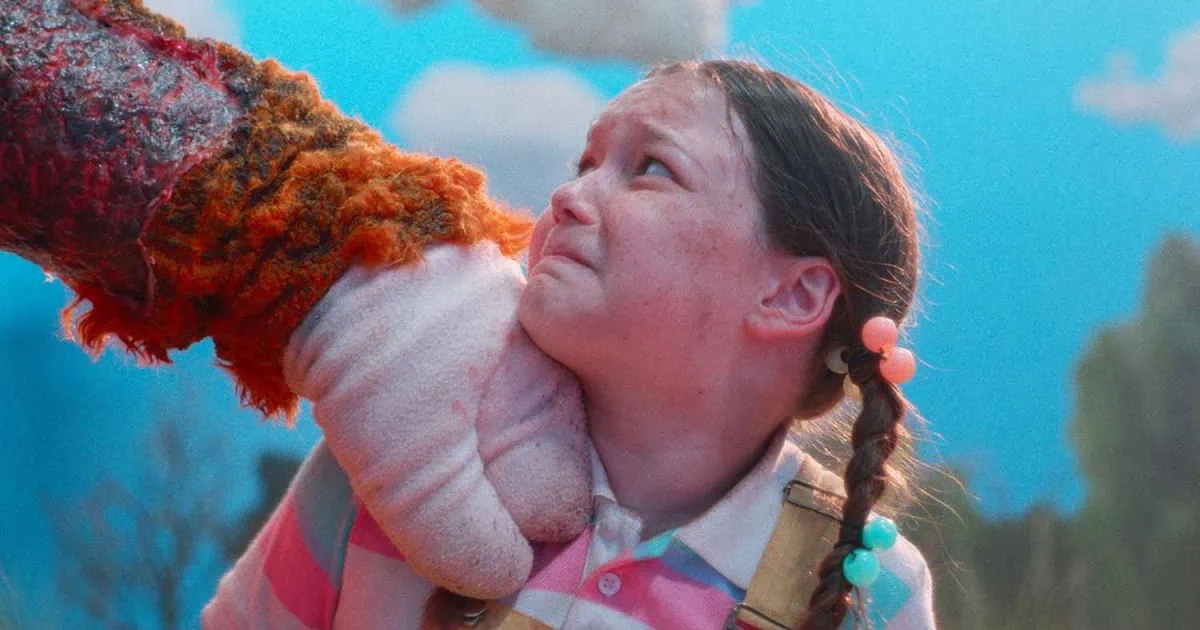
Casper Kelly’s Buddy, a surreal, satirical comedy-slasher about an anthropomorphic orange pony who traps children in his cursed playhouse, would say that it is. We’re dropped into this strange world through multiple episodes of It’s Buddy, an in-universe (or possibly out of this universe) television program that bears all the markers of classic children’s entertainment: an animated cast of kiddos who love to dance and burst into song, a brightly colored mascot who’s here to teach said kiddos some morals, and a recursive sense of storytelling that results in the status quo never changing. Except it’s all pure evil, of course: Buddy is actually a psychopath who flips his lid whenever the kids talk back or disagree with him, and his outbursts quickly shift from unsettling to murderous.

While the first half-hour is solidly entertaining as an Adult Swim-style “what if Barney was evil” fever dream, Buddy gets less and less interesting as it goes on. It’s a film that only vaguely gestures to the idea that children’s media has sinister undertones, mainly because it has a tough time explaining why that is, exactly. While it’s true that Pee Wee’s Playhouse presents a view of the world that is hardly realistic, maybe that’s a good thing. The antagonist of Buddy is a psychotic control freak who demands that his immature subjects dot every i and cross every t while adhering to his rules, but, frankly, the archetype this film is satirizing is blurry. Those PBS shows may have promoted sharing and caring in ham-fisted and artificial ways, but it feels lazy to point towards the general idea of “control” as a target for satire. It’s anti-nostalgia that comes more from adult imagination than any parallel in the real world, unless I’ve simply forgotten that Cliff Hanger from Between the Lions suggested you, too, should jump.
The secret to appreciating Buddy is realizing that it’s directed by the man who made Too Many Cooks, as well as Mandy’s Cheddar Goblin. This is a slasher mostly intent on prettying up its grade-A elevator pitch with some old-fashioned craft, which I’ll get to shortly. But this lack of narrative ambition also feels like a missed opportunity. When Buddy silently gropes the town’s nurse or gaslights the kids into thinking they didn’t see him strangle someone, they’re moments that feel more pointed—less an accusation of Barney leading to arrested development than the idea that the man behind the costume might be someone with ulterior motives. After all, it isn’t Drake & Josh or iCarly that scarred anyone, but rather the realization that that adults in powerful positions can infect anything, even a wholesome show made for—and with—kids.

I’ll admit that satire is a fickle beast and separating the critique from the criticism can be difficult. In any case, Buddy is still something of a mess, tonally or otherwise. We cut to the real world halfway through to introduce a mother (Cristin Milioti’s Grace) who realizes her daughter was napped by Buddy, and it’s a plotline that feels far more cliche than any overt metaphor that could be drawn in its place. (As Topher Grace expressed for the nth time that his wife must be crazy, the persons sitting to the left and right of me checked their phones simultaneously.) Meanwhile, on the run from Buddy and now caught in a strange, forested limbo, the children, newly freed from their televised cocoon, discover adult topics like swearing and homosexuality—again, any actual exploration is passed over in favor of the bloodletting, and even though the ending admirably reaches for the sky by raising more questions than answers, it’s the thematic queries that have zero intrigue. (“Who are you?” a concerned adult asks Freddy in the final shot. Clever.)
Still, while Buddy might struggle to find anything interesting to say about children or children’s media, there’s a lot of inspired filmmaking to be admired. The kids are all fine actors, the puppetry and set design is tremendous, and formally, Buddy is a big winner. As a lifelong fan of playing around with film-within-a-film stuff like diegetic music cues and shifting aspect ratios, I was left wanting even more. Buddy has plenty of curveballs in its arsenal, like a monstrous, practically constructed demonic final form for its antagonist, a backrooms-esque conspiracy involving how kids are sent to this world in the first place, and Buddy-on-talking-couch violence, and yet I could feel Kelly being restrained by trying to marry his truly bizarre sensibilities with the structure of a three act slasher. I truly believe you could squeeze a full feature out of the beginning’s faux episode structure, and likely a better one.
Clearly, I have my gripes here, but I do like to lean positive whenever a unique premise meets a unique filmmaker, and that is exactly what we have with Buddy. As it so often happens with these horror debuts, it is not the form or the skill or the creativity that is lacking, but the ability to elucidate something beyond the obvious. For less demanding viewers, it will be enough to finally have a film that acknowledges Barney has always been a little creepy. For others, the promise of the first thirty minutes will leave the rest of Buddy feeling like a pulled punch. 8-29-26


Leave a Reply